Rent vs. Buy in 2026: The Math That Actually Matters
Should you rent or buy a home in 2026? Forget the emotional arguments. Here's the actual financial math to help you make the right decision for your situation.

John Mitchell
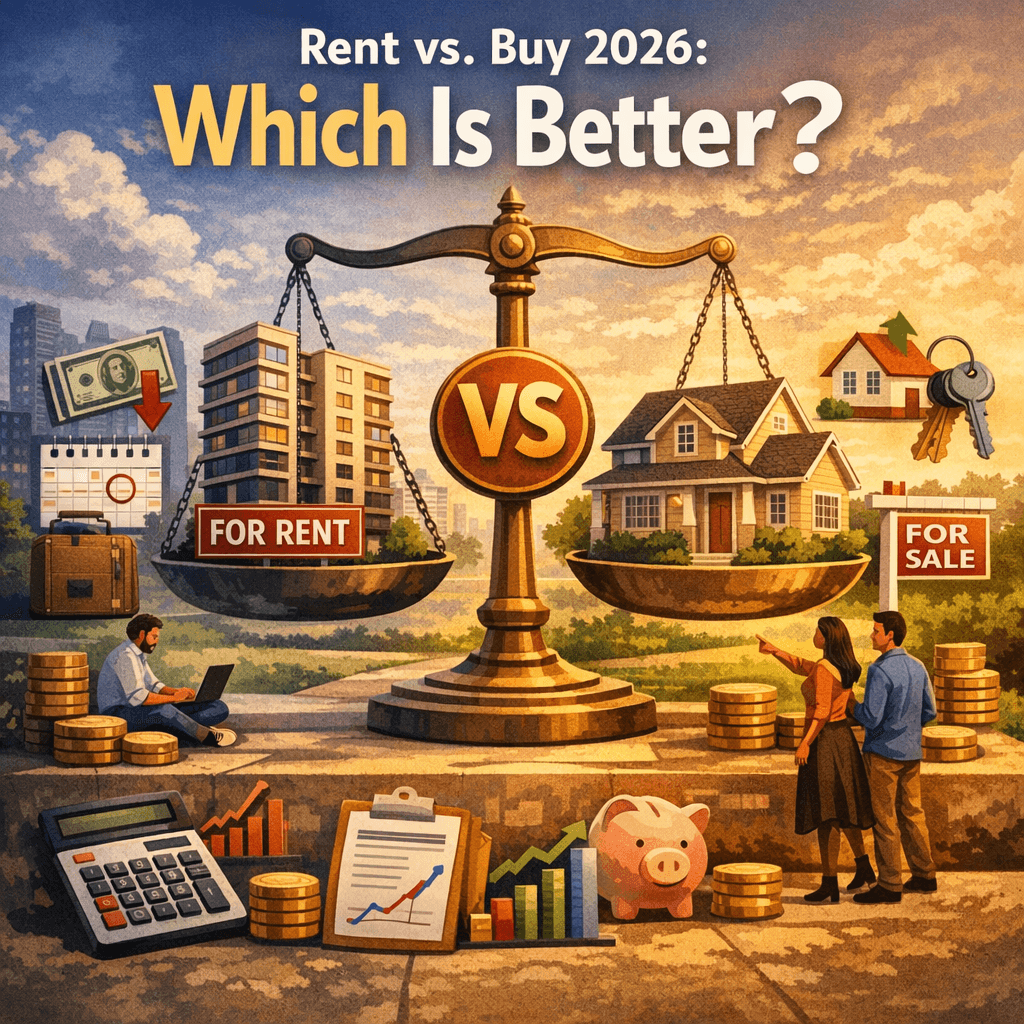
"Renting is throwing money away."
I've heard this a thousand times. It's one of the most persistent myths in personal finance. And it's caused countless people to buy homes they couldn't afford, in markets that didn't make sense, at times that were wrong for their lives.
Let me be clear: homeownership can be a great financial move. But it's not always the right choice, and in 2026, the math is more complicated than ever.
Let's break it down.
The Real Costs of Buying
When people compare renting to buying, they usually compare rent to a mortgage payment. That's a mistake. The mortgage is just the beginning.
The true cost of homeownership includes:
- Mortgage payment (principal + interest)
- Property taxes (1-2% of home value annually in most states)
- Homeowners insurance ($1,500-$3,000+/year depending on location)
- PMI (if you put down less than 20%: 0.5-1% of loan annually)
- Maintenance (budget 1-2% of home value per year)
- HOA fees (if applicable: $200-$500+/month)
- Closing costs (2-5% of purchase price when you buy)
- Selling costs (5-6% when you sell, plus staging, repairs)
Let's run real numbers on a $400,000 home:
- Mortgage (6.5%, 30yr, 20% down): $2,023/month
- Property taxes (1.2%): $400/month
- Insurance: $200/month
- Maintenance (1.5%): $500/month
- Total: $3,123/month
That's before any HOA, before any unexpected repairs (roof, HVAC, plumbing), and before you count the $80,000 you tied up in a down payment.
The Real Cost of Renting
Renting is simpler:
- Monthly rent
- Renters insurance (~$15-30/month)
That's it. No surprise repairs. No property tax hikes. No worrying about the roof.
In many markets, you can rent a comparable home for significantly less than the all-in cost of owning it.
The Price-to-Rent Ratio
Here's a quick rule of thumb to compare:
Price-to-Rent Ratio = Home Price ÷ (Annual Rent)
- Under 15: Buying is probably better
- 15-20: It's a toss-up, depends on your situation
- Over 20: Renting is probably the smarter financial move
Example:
- Home price: $400,000
- Monthly rent for similar home: $2,000 ($24,000/year)
- Ratio: 400,000 ÷ 24,000 = 16.7
That's borderline — could go either way depending on other factors.
In many hot markets (Bay Area, NYC, Austin, Miami), the ratio is 25-35+. In those places, renting is often dramatically cheaper.
The Opportunity Cost of Your Down Payment
This is the hidden cost most people ignore.
That $80,000 down payment on a $400,000 house? If you invested it in the S&P 500 instead, historically you'd average about 7% real returns (after inflation).
$80,000 invested at 7% for 10 years = ~$157,000
That's $77,000 in growth you're giving up by tying your money up in a house. Yes, the house might appreciate too — but home appreciation historically tracks inflation (around 3-4% nationally), not stock market returns.
When Buying Makes Sense
Buying is the right move when:
- You'll stay 5+ years — Transaction costs eat you alive if you move quickly
- The price-to-rent ratio is under 15 — Buying is significantly cheaper
- You have a stable income and job security — A mortgage is a long-term commitment
- You have a 20% down payment — Avoiding PMI improves the math
- You have an emergency fund AFTER the down payment — Don't drain everything
- You actually want to own — The yard, the stability, the freedom to modify
When Renting Makes Sense
Renting is the smarter choice when:
- You might move within 3-5 years — Job change, relationship change, life change
- The price-to-rent ratio is over 20 — You're paying a premium to own
- You don't have a full down payment saved — PMI hurts the math
- Your job/income is unstable — Flexibility matters
- You'd rather invest the difference — And you actually will invest it
- You hate home maintenance — Roofs, plumbing, and HVAC aren't fun
The 2026 Factor: Interest Rates
Mortgage rates in early 2026 are hovering around 6.5%. That's significantly higher than the 3% rates people locked in during 2020-2021.
At 3%, the monthly payment on a $320,000 loan (80% of $400K) is: $1,349 At 6.5%, that same loan costs: $2,023
That's $674/month more — $8,088/year — just because rates are higher. Same house, same price, $674 more per month.
This doesn't mean "don't buy." But it does mean the math has shifted. Buying made obvious sense at 3%. At 6.5%, you need to run the numbers carefully.
The Myth of "Building Equity"
"But when I pay my mortgage, I'm building equity!"
True. But in the early years of a 30-year mortgage, most of your payment goes to interest, not principal.
On a $320,000 loan at 6.5%:
- Month 1: $1,733 to interest, $290 to principal
- After 5 years: You've paid ~$121,000 total, but only ~$22,000 went to principal
Meanwhile, the renter who invested $80,000 (the down payment) might have $112,000+ in their brokerage account.
Equity builds slowly. Investment accounts can grow faster.
The Emotional Factor
I've given you the math, but I'll be honest: this isn't purely a math decision.
Owning a home provides:
- Stability (no landlord selling the building)
- Freedom (paint the walls, get a dog, renovate)
- Community roots (especially important for families)
- Forced savings (you WILL build equity eventually)
Renting provides:
- Flexibility (move when you want)
- Simplicity (call the landlord when stuff breaks)
- Liquidity (your money isn't locked in walls)
- Lower stress (market crashes don't affect your housing)
Both are valid. Neither is "wrong."
The Bottom Line
Stop listening to people who say renting is "throwing money away" or that you "must" buy a home. These are lazy takes that ignore math and personal circumstances.
Run the numbers for your specific situation:
- Calculate the true all-in cost of buying (not just mortgage)
- Compare to rent for a similar property
- Consider how long you'll stay
- Factor in the opportunity cost of your down payment
- Be honest about your life stability and preferences
Sometimes buying wins. Sometimes renting wins. In 2026, with elevated rates and high prices, renting wins more often than many people expect.
Don't let anyone pressure you into the biggest purchase of your life based on a bumper sticker slogan.
Continue Reading
More from Real Estate
 Real Estate
Mortgage Rates Just Dropped Below 6% — Is Now the Time to Buy?
30-year mortgage rates have dipped below 6% for the first time in months. Here's what it means for homebuyers and whether you should act now.
 John Mitchell
You May Also Find Interesting
 Investing
China Tells Banks to Cut US Treasury Holdings: What It Means for American Investors
Chinese regulators are urging banks to reduce their US Treasury exposure. Here's what this trend means for interest rates, the dollar, and your portfolio.
John Mitchell Investing
How to Start Investing With $100 (A Beginner's Guide for 2026)
You don't need thousands to start investing. With just $100 and a smartphone, you can begin building wealth today. Here's exactly how to do it step by step.
John Mitchell Retirement
401(k) Basics: Everything You Need to Know in 2026
Your employer offers a 401(k). Should you use it? How much should you contribute? What's a match? Here's the complete beginner's guide to the retirement account that could make you a millionaire.
John Mitchell Investing
Dow Hits 50,000 for the First Time — What It Means for Your Portfolio
The Dow Jones Industrial Average closed above 50,000 for the first time in history on Friday. Here's what drove the rally and what this milestone actually means for everyday investors.
John Mitchell